
Our Time Is Running Out!
This is post 1 of 1 in the series “climate change”
In recent weeks, news of disasters seems to have filled the news and social media timelines. Severe wildfires in California and Turkey, floods in Germany, China, and India, and landslides in Japan. In Indonesia, a savanna forest fire broke out in the Komodo National Park area on Saturday, August 9.
Worried by this flood of disaster news, I tried to find out what lies behind it. It turns out that the increasing frequency and severity of these disasters is a real impact of the climate crisis. According to the United Nations Intergovernmental Panel on Climate Change, or IPCC, our planet has already warmed by 1.1℃ since pre-industrial times. This makes the cycle of disasters faster and their impacts worse. Heavy rain that was expected to occur once every 10 years is now happening 30 percent more often. Globally, extreme droughts that usually occur once every 10 years are projected to happen 70 percent more often.
IPCC is a body or panel under the United Nations (UN) mandated to assess climate change caused by human activity, the impacts that will occur, and the solutions that can be applied.
On Monday, August 9, 2021, the IPCC released its latest report. There are several important points we should pay attention to from this report, including:
By 2040, the Earth’s temperature will exceed 1.5℃
In the next two decades, we will keep witnessing various forms of increasingly frequent disasters. Moreover, their impacts will become ever more deadly. This is because the Earth’s temperature will continue to rise globally. If you already feel that the weather in Indonesia is very hot this year, this condition will likely continue to worsen.

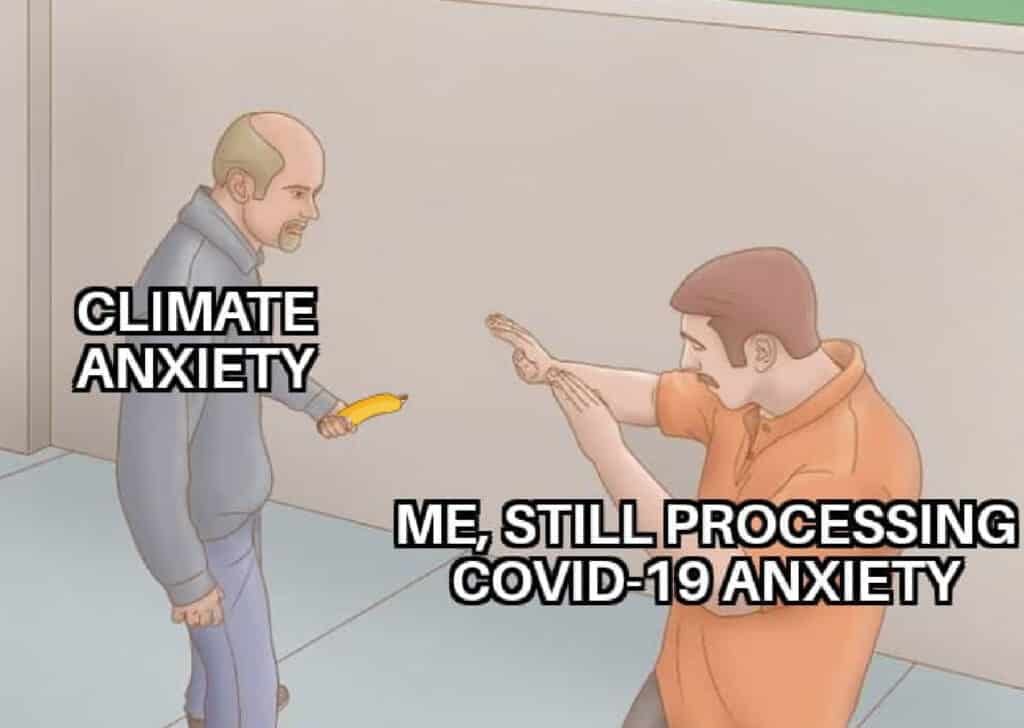
(Source: 9GAG)

The deadly impact of this temperature rise is already being felt by fish in the sea, you see! A video circulating a few weeks ago showed salmon in the Columbia River with injuries caused by water temperatures that had become too hot for them to live in (reaching 21℃) due to heat waves.
Human activity is the main cause of global warming
Human activity during the industrial era has extracted natural resources on a massive scale, exceeding nature’s capacity to provide them. Companies and extractive industries play a major role in causing the climate crisis. Did you know that 71 percent of global greenhouse gases come from just 100 companies, most of them based in the developed countries of the North? Meanwhile, countries in the South will be hit especially hard because they are more vulnerable than Northern countries. On July 27, Finance Minister Sri Mulyani stated that the impact of the climate crisis will be comparable to the Covid-19 pandemic, and poor countries will likely feel the impact far more severely.
“Climate change is a global disaster whose magnitude is expected to be similar to the Covid-19 pandemic. No single country will be able to escape the threat of climate change. Climate change is a real global threat that has been studied by many scientists, who describe that this world is experiencing global warming.”
(Finance Minister Sri Mulyani in the ESG Capital Market Summit, Tuesday, July 27, 2021)
Tipping point: there is no way back
The scientists who wrote the IPCC report say that we are getting ever closer to a tipping point, or peak point, of climate change. Once that point is crossed, there will be no way or means to restore the climate to what it was before. 😱😱😱
All the news is so bad, what should we do? 😱😱😱
The current situation is already very bad. And if we do nothing, a catastrophe beyond imagination will happen. The most important players in stopping this are world leaders. In November 2021, heads of state will gather in Glasgow to attend the COP26 meeting. Indonesia is one of the countries that will take part.
One thing we can do is monitor and make sure our leaders are truly serious about working to prevent extinction. We can convey our demands to the government to ambitiously work toward reducing Indonesia’s net carbon emissions to zero by 2025. This is the best choice to avoid worsening the damage and extinction already underway. Sign petitions, take climate action, and keep pressing the government through various communication channels. Some movement bases you can check out are Extinction Rebellion Indonesia, Jeda Iklim, or Bersihkan Indonesia.
It is time for all of us to start moving to push for systemic change. You and I, who may be students or ordinary workers, can urge the government to get truly serious about stopping the climate crisis.