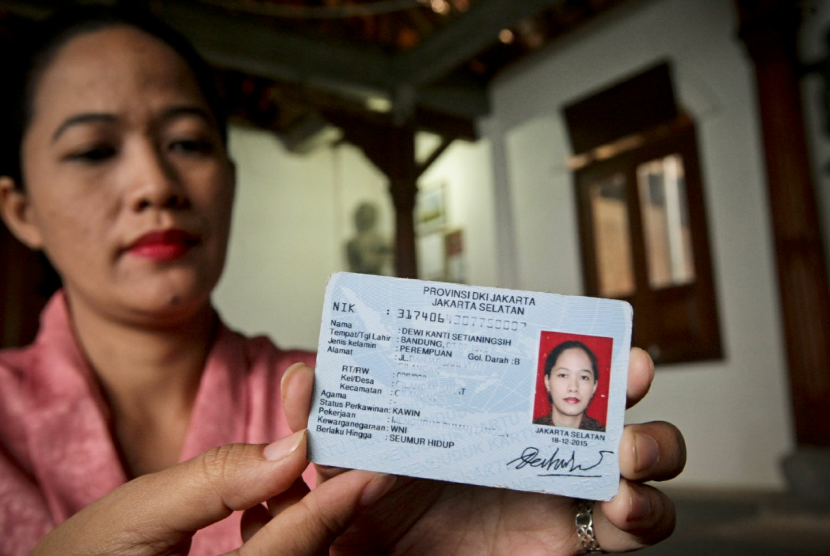
Recently, a Constitutional Court ruling declared that adherents of religions outside the six official religions may list their belief in the religion column of the Identity Card (KTP). So how important is this decision for followers of religions the state has not recognized until now?
Having a religion became important in Indonesia after Pancasila was adopted as the state guideline, especially after Presidential Decree No. 1 of 1965 was enacted during the New Order era. This law regulated which religions are practiced by Indonesian citizens and recognized by the government.
Unfortunately, because of that regulation, a number of religious adherents were not recognized and were not facilitated by the state. Examples include Sunda Wiwitan, Kaharingan, Parmalim, and others. According to records from the Ministry of Education and Culture in 2017, there are around 187 beliefs in Indonesia[1] with a total of more than 12 million followers[2]. Have you ever heard of these religions before?
Some of these religions grew and developed before the religions regarded as official, such as Islam, Christianity, Catholicism, Buddhism, Hinduism, and Confucianism, entered Indonesia. Sunda Wiwitan, for example, already existed in the Sunda land, Banten and West Java, before Islam developed there. Meanwhile, Aluk Todolo was already practiced by the residents of Tana Toraja before Christianity spread in that region[3].
Because they are not designated as official religions, local religions end up as ‘strip religions’ (agama strip), meaning they are not listed on the KTP. This is stated in Article 61 of Law No. 23 of 2006 and Article 64 of Law No. 24 of 2013. Civil registry officials usually put a dash in the religion column. Sometimes adherents of religions not considered official are also forced to choose one of the recognized religions to fill that blank, even though they do not truly embrace or practice that religion’s teachings.
It does not stop there. The empty religion column turns out to have a big impact on the lives of adherents of unrecognized religions. For example, they receive bad stigma and are often labeled as PKI or atheists just for leaving the religion column on their KTP blank. Many also have difficulty finding work, especially those who want to become civil servants or join the TNI. Marriages between adherents of religions outside the government’s official versions are also not recognized in civil registries. Even the wish of a Sapto Darmo family to bury a relative in a public cemetery was rejected by residents because of their differing beliefs.
Last year, a student in Semarang failed to move up a grade because he refused to take the practical exam in his school’s religious education, since he was not actually an adherent of the religion being tested. The school was also reluctant to offer a solution and said that it only recognizes religious education grades listed in the curriculum. At such a young age, this vocational high school student had to face the reality that, because of his beliefs, he was excluded from his country’s system.
Having experienced discrimination for years and not wanting its impact to pass on to their children, four applicants from different beliefs, Nggay Mehang Tana (Marapu), Pagar Demanra Sirait (Parmalim), Arnold Purba (Ugamo Bangso Batak), and Carlin (Sapto Darmo), fought a lawsuit against the Population Administration Law. Two days ago, the Constitutional Court finally ruled that followers of belief systems have the right to write their beliefs and convictions in the religion column of the KTP.
The number of followers of these religions is indeed not as large as that of the officially recognized religions according to the government. But that does not mean their rights and roles can be dismissed as citizens, let alone as human beings. Everyone in this country has the right to civil administration services, health guarantees, and the opportunity to get decent jobs and education. All of this is stated in our Constitution.
Source:
[2] https://news.detik.com/berita/d-3494828/mlki-penghayat-kepercayaan-12-juta-orang
[3] https://tirto.id/agama-agama-yang-dipinggirkan-bnP3
Photo:
Jakarta Globe