Written by raafi
“Violence has always begun with the formation of oppression and the relationship between the oppressor and the oppressed. Never once in history has violence been initiated by the oppressed.”
(Paulo Freire, Pedagogy of the Oppressed)
Imagine your house is surrounded, deliberately set on fire, and its door locked from the outside by thieves who want to seize your land. Would you knock on the door slowly and politely, hoping someone will open it, or would you break it down with whatever is around you until the hinges give way? The answer naturally depends on how fast the fire spreads and how thick the door is. But one thing is certain: that situation does not happen in a vacuum. There is an imbalance of power between the thieves, who actively want to destroy the house, and its owner. In the discourse of resistance, society often demands that the victim being burned “knock politely,” and condemns them when they choose to break the door down.
Protests are often judged with a rigid moral compass. Nonviolence is idolized as the only “sacred path” of lofty value, while confrontational actions or riots (riots) are hastily branded as destructive. This binary view turns tactics of action from political instruments into a matter of life faith: they must be held firmly and never questioned. In fact, confining resistance within such a moralistic framework is a mistaken view. Violence, nonviolence, and the entire spectrum of actions in between are not matters of faith; they are strategies.
Asking abstractly which approach is “more effective” is also a mistaken question, because it isolates tactics from their essential requirement: they must be read with consideration of context, calculation of resources, and the repressive space provided by the rulers. Historically, nonviolent and confrontational actions have often been intertwined and overlapping. Without a real threat that disrupts stability or economic chains, opponents are rarely moved by appeals presented politely.
This does not mean nonviolent action never succeeds. In contexts where a movement has a widely organized mass base, more stable resource support, and a political space that allows negotiation, nonviolent tactics prove remarkably powerful. Just look at the Montgomery Bus Boycott (1955–1956), organized by Black residents after the arrest of Rosa Parks.
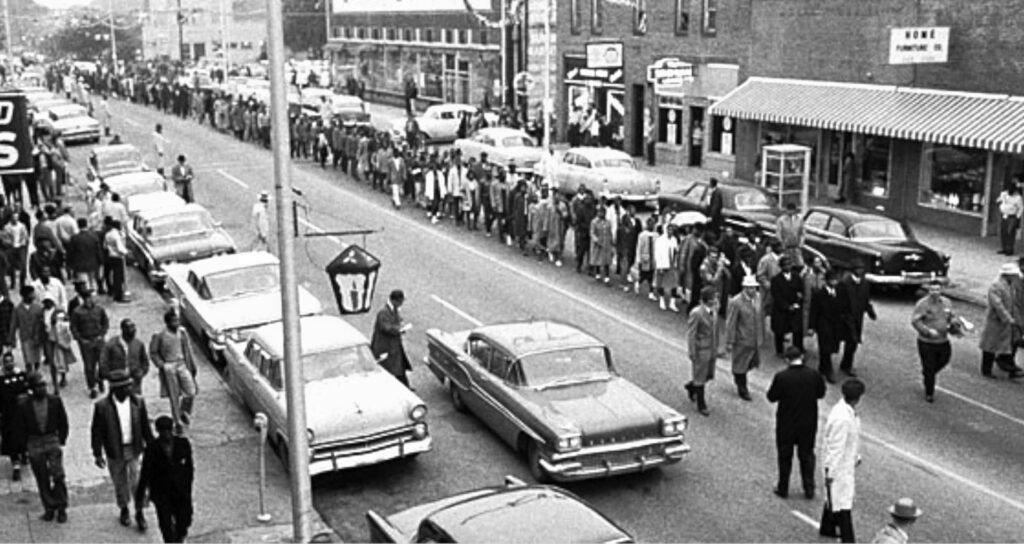
This movement did not win merely because it held to the morality of “nonviolence,” but because of strategic organizing: for 382 days, more than 40,000 Black residents refused to ride the buses, built a carpool system (sharing rides), and Black churches collected money and new shoes to replace the worn-out footwear of Black Montgomery residents who had to walk kilometers. All of this was done to undermine 70% of the city’s public transport revenue. The tactic was considered successful in destroying the financial stability of the opponent and putting reputational pressure on the rulers, until they finally surrendered. Not because the rulers suddenly grew morally sensitive, but because the economic and political cost of maintaining a system of racism had become too expensive to bear.
However, when the channels for compromise are tightly shut and violence is unleashed recklessly through legal, military, religious, and other instruments, history records that radical systemic change and efforts to preserve existence almost always require confrontational escalation. The Stonewall riots (1969) in New York, for example, took place where gay, trans, drag queens, and other marginalized people lived under the pressure of a very repressive US legal system, and police raids on queer bars were considered routine.
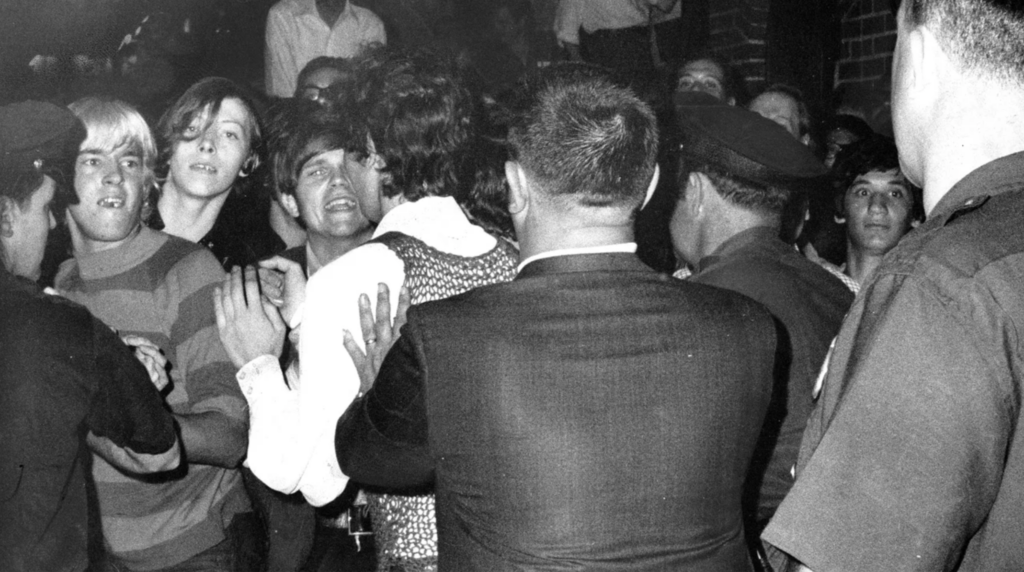
The raid on the Stonewall Inn that night was met with an explosion of physical confrontation over several consecutive nights. Parking meters were pulled up and used as battering rams against the door, bottles and stones flew, barricades were erected, and the police ended up fleeing and locking themselves inside the bar. This open confrontation not only drove the police back, but also fundamentally revolutionized the system of the liberation movement: it destroyed fear, ended the dominance of the narrative that queer people must behave “politely” to be accepted, and gave birth to radical organizations such as the Gay Liberation Front (GLF) and Street Transvestite Action Revolutionaries (STAR). Without the courage to defy racist and homophobic legal rules that night, the modern civil rights movement would never have shifted the political landscape so massively as it does today.
Let us see how the dynamics of these tactics are in fact more nuanced within liberation movements, in Palestine and Papua for example. In Palestine, the people face genocide and colonialism by Israel. Hunger strikes, peaceful demonstrations such as the Great March of Return, and even the escalation to armed martyrdom on the front lines cannot be separated from one another. The same goes for Papua, where living space is continually eroded by militarism and extractivism. When formal diplomacy is silenced and peaceful action is met with bullets, confrontational tactics become a form of self-defense to protect the existence of their customary lands.
Spectators outside the circle of conflict often demand that those being oppressed act politely, neatly, and orderly so that their resistance deserves sympathy. In fact, politeness in politics is nonsense. Such a demand is like forcing someone being choked to choose poetic words while calling for help. The rule that “you must be orderly” is itself made by the rulers so that their sense of safety and comfort is never truly disturbed. Therefore, demanding that oppressed citizens take peaceful paths shaped by their oppressors is no different from repeating the rhetoric of oppression and preventing true liberation from happening.
Indeed, confrontational tactics carry a double consequence: they can pressure institutions and draw public attention dramatically, but at the same time risk lowering the sympathy of ordinary people. However, measuring the success of an action only by its concrete results today is a shallow way of thinking. Burning barricades or the stubborn resistance of those holding their ground against tear gas function as symbols of resistance. Even if an action fails to change policy at that very moment, it can ignite radical imagination, erode the feeling of helplessness (learned helplessness), and give birth to a new generation of activists who believe that a better life is possible to seize and fight for.
Above all, the question of tactics ultimately comes down to positionality and embodied experience. It is quite ridiculous when observers who live comfortably within circles of privilege – who have never felt the sting of tear gas, whose homes have never been evicted, and whose bodies do not bear the risk of criminalization – feel entitled to become moral police for how others resist.
Who are we to dictate how others gamble their lives to survive?
Oppression is felt very real on the bodies of those who are marginalized. Therefore, only those who are oppressed have the absolute right to determine which range of tactics they wish to use to reclaim their land and their humanity. Outsiders have no ethical legitimacy to lecture, judge, let alone dictate the “proper” way for others to resist.
When the streets erupt and barricades go up, our task is not to act as moral mentors who judge their tactics. Our task is to dismantle the structural conditions of oppression that force those tactics to be taken. For if the systemic violence of the state and corporations takes away people’s living space every day, are we still justified in demanding that the desperate groan in language that pleases the ears of their oppressors?
Check the texts below to read more about direct action, nonviolent strategy, and political ethics:
Direct Action
Gelderloos, P. (2007). How nonviolence protects the state. https://theanarchistlibrary.org/library/peter-gelderloos-how-nonviolence-protects-the-state
Graeber, D. (2009). Direct action: An ethnography. Ak Press.
Loadenthal, M. (2017). The politics of attack: Communiqués and insurrectionary violence. Manchester University Press. https://www.jstor.org/stable/j.ctv18b5k7t
Sovacool, B. K., & Dunlap, A. (2021). Anarchy, war, or revolt? Radical perspectives for climate protection, insurgency and civil disobedience in a low-carbon era. Ssrn.Com. https://papers.ssrn.com/sol3/papers.cfm?abstract_id=3979688
Nonviolent Strategy
Nagler, M. N. (2014). The nonviolence handbook : A guide for practical action. Berrett-Koehler Publishers, Inc.
Popovic, S., Djinovic, S., Milivojevic, A., Merriman , H., & Marovic, I. (2007). Centre for applied NonViolent action and strategies core curriculum. Centre for Applied Nonviolent Action and Strategies.
Political Ethics
Davis, A. Y. (2016). Freedom is a constant struggle: Ferguson, Palestine, and the foundations of a movement. Haymarket Books.
Hansson, E., & Weiss, M. L. (2023). Routledge Handbook of Civil and Uncivil Society in Southeast Asia. Taylor & Francis.