Indonesia today stands on the mass graves of one million people who were brutally killed in 1965–1966. It is wrapped in anti-communist rhetoric, fueled by hatred based on social group, ethnicity, and gender, protected under state propaganda, and supported by American imperialism. Carried out as one of the United States’ totalizing agendas to rule by “cleansing” the world of communism, this historical trauma shaped the contours of the world power we know today.
After the formal fall of the New Order, civil society elements have made various efforts to demand state accountability, historical recognition, and the recovery of all survivors and their families. Even so, to this day, that historical debt is still far from paid off.
As a generation that grew up half a century later, we did not witness those bloody years firsthand, nor were we targets of the history-cleansing propaganda that followed, such as film screenings in schools.
Nevertheless, fortunately, many of us have been exposed to critical perspectives on the history of the 1965 mass killings through the media, civil society gathering spaces, books, films, literature, and even music. Some of us even learned about it from oral histories passed down within our families.
As September closes, Pamflet Generasi discussed works that invite us to get to know the 1965 mass killings more deeply. When the formal school curriculum covers up the 1965 mass killings, and conversations about them cause tension in family living rooms, what helps us understand it?
The Poem ‘Tini dan Yanti’ by Ida Bagus Santosa
— by Widya (Communications Staff)
“This poem was written in a prison cell by Ida Bagus Santosa, a writer in Bali who became a political prisoner in 1965. After some time in prison, he disappeared and was killed. The poem was addressed to his wife, Tini, and to Yanti, their child who had just been born.
‘Tini dan Yanti’ contains Mr. Ida Bagus’s greetings of affection and farewell to his family, with exile and death seemingly inevitable for him. Though written under pressure, this short poem remains full of ideological dreams of liberation. For example, in one passage he writes that he has no gift to offer, only a love for a freedom yet to come.
I first encountered this poem in early adolescence. It may be one of the most progressive artworks from Indonesia that I know. Since then, not only about the 1965 mass killings, I have also learned that the imagination of shared freedom and justice is a force for life. It is a passion that should always be nurtured, even in the face of a terrifying crisis.
After Mr. Ida Bagus’s enforced disappearance or death, this poem is said to have often been sung in prison cells to pass on spirit to political prisoners. Today, many musical projects have adapted it into poetry-music, among them Taman 65 and Banda Neira.”
The Song ‘Garuda Pancasila’ by Sudharnoto
— by Mann.Bait (Youth Movement Staff)
“Perhaps I, or you, knew Garuda Pancasila long before I knew who created it. Since childhood, this song has been present at school, in ceremonies, and in formal spaces that taught me about Indonesia and Pancasila.
But then I learned that this song was created by Sudharnoto, an artist active in Lekra (the People’s Culture Institute). Lekra was a cultural organization founded in 1950 that encouraged art to be close to the lives and problems of the people. Over time, Lekra had a political closeness to the PKI. After 1965, people considered linked to Lekra experienced various forms of repression. After 1965, he too experienced repression: he was dismissed from RRI and was briefly detained.
That was when I began to hear this song in a different way.
Something felt strange: a song about Pancasila and love for Indonesia continues to live on and be sung by generation after generation, while the person who created it was pushed aside because of his political and cultural choices.
For me, Garuda Pancasila ultimately is not only a song about nationalism. It also reminds me that Indonesian history is not always as simple as a story about who is nationalist and who is considered not part of the nation.
There were people who once imagined Indonesia in their own way, created works, contributed ideas, and then history made them seem as though they never existed.
Perhaps that is why, every time I hear Garuda Pancasila, I no longer think of Pancasila only as something to be memorized. I also think of the people who lived, worked, and dreamed about Indonesia, including those who were later forced into silence.
Remembering 1965, for me, also means trying to return them to the story of Indonesia.”
Woodcarving by Simbah Buyut
— by Ai (Pamflet Friend)
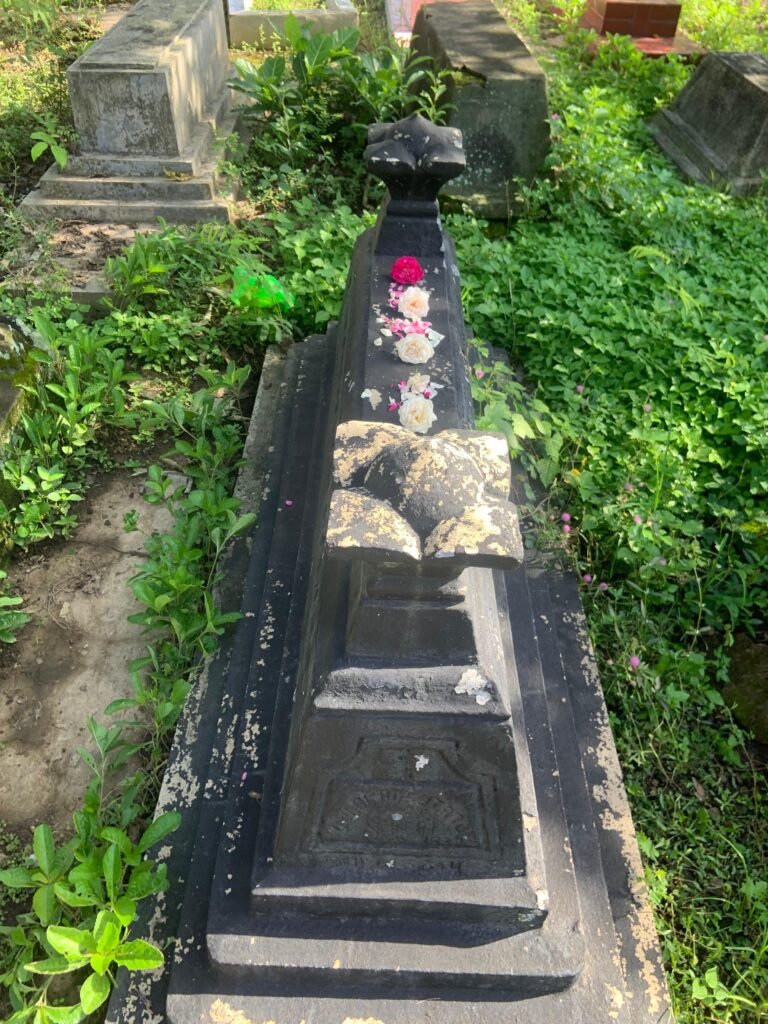
“There is no visual documentation or archive of the woodcarving work of my Simbah Buyut (great-grandfather) that I can find, apart from the memories of my Mbah Putri (grandmother). She passed on this oral history in 2015 on the porch of her house in Klaten, Central Java. Simbah Buyut, Mbah Putri’s father, was a woodcraftsman. He made wardrobes and chairs and carved wood; “artistic at heart,” as Mbah Putri put it. A few months after 1 October 1965, a group of people came to Mbah Putri’s house looking for her father. His background as a craftsman was then linked to his affiliation with the Lekra group in Klaten. I do not remember exactly what happened next, but Mbah Putri told me that Simbah Buyut managed to hide and survived.
Boyolali and Klaten regencies were among the well-organized PKI strongholds, so many victims of enforced disappearance who were considered affiliated with the party came from this area. The days full of anxiety that Mbah Putri’s family lived through continued for several years afterward.
“That night, Mbah Kakung took us to hide in the rice field; your budhe was still three months old.“
(That night, Mbah Kakung (grandfather, Mbah Putri’s husband) took us to hide in the rice field, while your budhe was three months old.)
Mbah Putri also recounted that one day the river near the house overflowed after rain all night. The next day, along the riverbank and all the way to the road, human remains were found. Everyone became quieter from that day on. The village grew silent, and gathering in groups of more than three people became risky. In the years that followed, Mbah Putri marked the points of mass graves around her house.
Mbah Putri was only able to share this oral history and embodied experience after fifty years had passed. Mbah Putri passed away in September 2024, but this archive of ordinary people’s history will continue to be pursued by her children and grandchildren so that it stays alive.”
Exhibition ‘Objects that Remember’ (2026) at the International Institute of Social History (IISG) in Amsterdam, the Netherlands
— by Raafi (Youth Movement Staff)
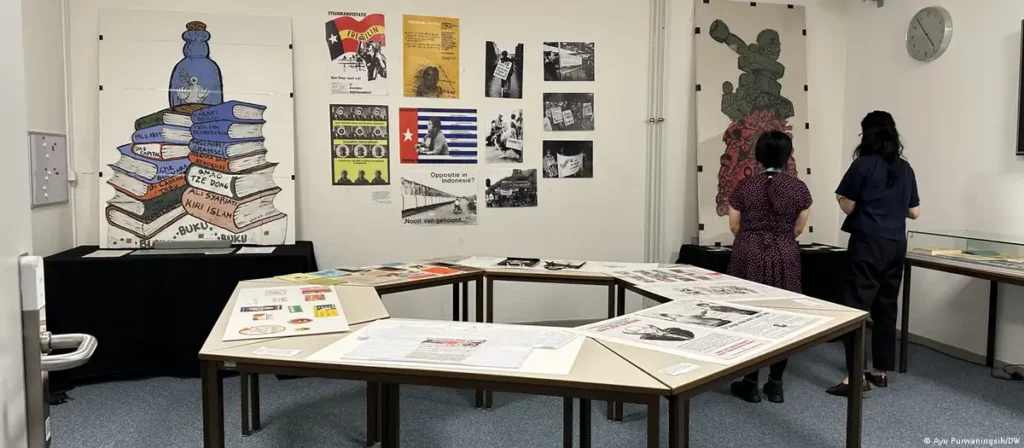
“When we hear the word ‘exile,’ what usually comes to mind is a person: people forced to leave their homeland, cast out, and living far from the place they call home. But at that exhibition, the concept of ‘exile’ is not only for humans. Their belongings also become exiles.
After the ’65 genocide erupted, Indonesian exiles could only bring the few belongings that fit in a suitcase. These simple objects, from cassette tapes and journals such as Mimbar, Kreasi, and API, to diaries, traveled across countries and decades, just like their owners. And not only that, there were also items “thrown out” of Indonesia because the regime deemed them dangerous: books on leftist thought, resistance paraphernalia of the PRD and JAKER, works by Taring Padi, and activist posters that were erased. These items were forced to seek refuge in the Netherlands so they would not be destroyed, so their memory would not be burned.
I did not see the exhibition in person in the Netherlands (of course, boss, there was no money!), but when I read the context of its launch and its catalogue, it hit me. “DEG!” (a heartbeat-like jolt), is roughly how it felt, as if my chest had been struck.
These objects remind me of how rich the thinking and intellectual capacity of young people and artists in the past were. They thought about the nation’s future deeply, critically, and courageously. But at the same time, how painful it is that we lost them. This nation lost a generation of its finest intellectuals and artists. Some were slaughtered, some were exiled, and some were disappeared without a trace until today.
What is displayed in ‘Objects That Remember’ is not just random, dusty artifacts, but also proof that there is a past that is not yet finished. The wounds of ’65 did not stop in that year. They spread through the legacy of New Order authoritarianism, whose effects we still feel today. Looking at the catalogue, I was once again made aware that the democratic space we have today was built on the courage of those who were silenced. Democracy is never enjoyed as a free gift from the goodwill of rulers; it is always seized and fought for by the people.
Finally, this exhibition reaffirms the importance of preserving memory. Remembering is the quietest form of resistance we can practice today. These objects of exile seem to whisper to us who live in the present: that the resistance against injustice is not over, and that it is our task to keep preserving that memory so history does not repeat itself.”
Mural ‘Ya Viene Djakarta’
— by rehann (Youth Activism Division Coordinator)
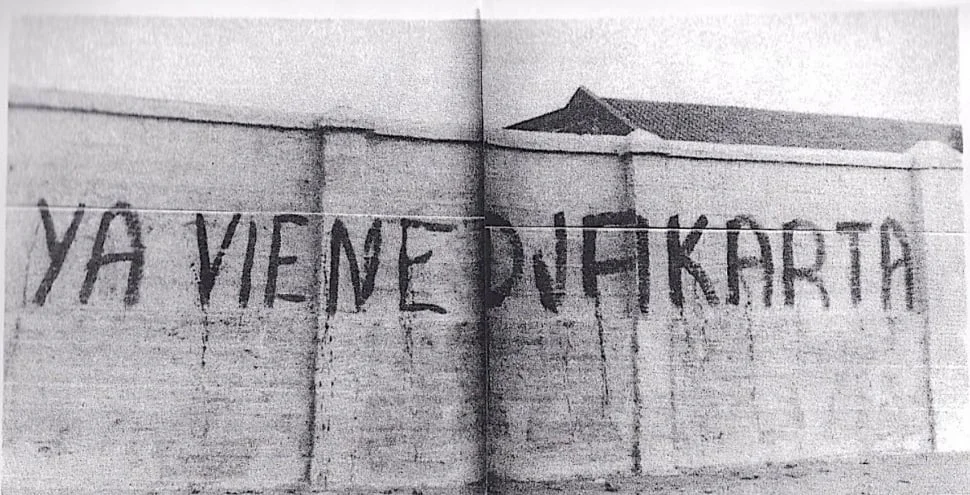
“As someone who grew up and was then pushed to the margins, Jakarta as a noun has many definitions in my head.
At annual moments like Eid, Jakarta means pilgrimage and retracing one’s roots. At another time, as a teenager going through a crisis of identity, Jakarta meant being cool and trendy. When I was in college, I also met a fellow migrant who understood Jakarta as a city that must be conquered before aging and returning home to rest.
At one point in 2022, one wall inside the exhibition hall of the National Gallery was apparently vandalized with large writing: “YA VIENE DJAKARTA,” meaning “Jakarta is coming.” That large writing was a replica of the murals that proliferated on the walls of Santiago, Chile in the late 1960s, as a threat of mass killing by hired muralists supporting the right wing, aimed at supporters of Salvador Allende, then Chile’s socialist former president.
Carmen Hertz, a female cadre of the Communist Party of Chile, received a postcard reading “Yakarta se acerca” and then suffered an assassination attempt.
The term “Operacao Jacarta” for an officer in Brasília some sixty years ago meant an order to carry out state terror against members of the Communist Party. Since that day, Jakarta has also meant, in my mind, mass slaughter by the state of many innocent people in many parts of the world. What happened in Jakarta at the end of September 1965 was exported, replicated, and reused again and again, from Solo, Gianyar, Medan, Pontianak, Santiago, and Brasília. To this day, Jakarta remains silent.”
Song ‘Salam Harapan’ by Dialita
— by Ann (Youth Studies Division Coordinator)
“‘Salam Harapan’ is a song written by Zubaedah Nungtjik AR and Murtiningrum, performed by the choir Dialita, a musical group made up of women who were political prisoners under the New Order and their family members.
If once a year we sing “Happy Birthday,” the political prisoners of ’65 felt that the “Happy Birthday” song “feels inappropriate for those who have been locked up for years,” explained Mrs. Uchi, one of the members of Dialita. That is why the song “Salam Harapan” was created. This song is often sung when a political prisoner has a birthday.
[Lyrics not reproduced here. The chorus speaks of steadfastness through hardship and of the belief that this unjust condition will not last forever, that freedom and reunion will come, and that the journey will reach the shore of hope.]
This song feels very warm because it carries steadfastness: the conviction that this condition of injustice will not last forever. There will be freedom and reunion after the uprooting that political prisoners have lived through.
During detention, political prisoners had very few ways to express themselves; they were not even allowed to write. They secretly composed songs behind iron bars, keeping alive their love for their children, family, community, and the homes they left behind.
Today, ‘Salam Harapan’ has become the title of Dialita’s latest album, which contains twelve songs. The album is sung not only by Dialita but also by various young musicians. “If young people find a song, then record it again (whoever finds it, and sing it for fun), that would be good,” hoped Mrs. Utati of Dialita.”
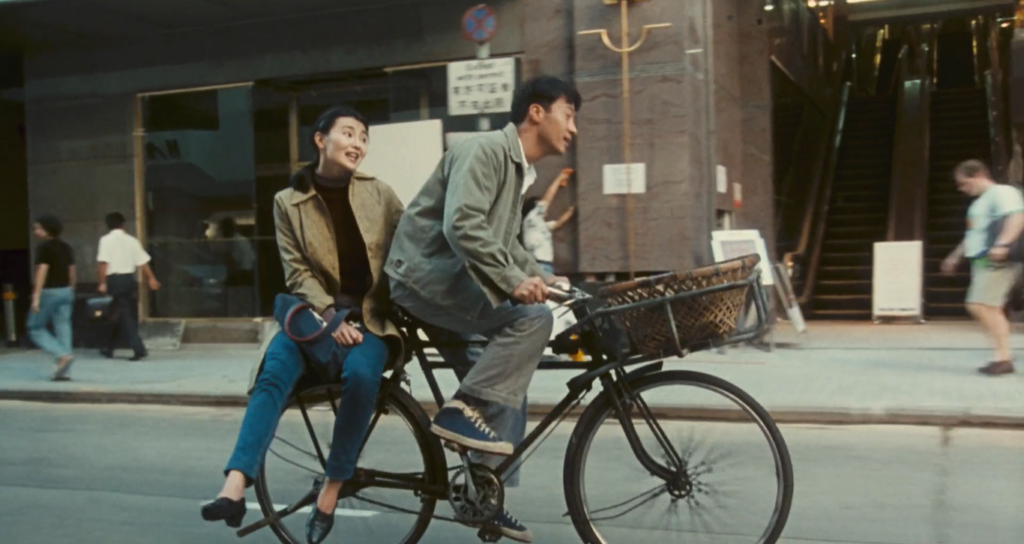
Film ‘You and I’ (2020)
— by Syauqina (General Coordinator, Pamflet Generasi)
“‘You & I’ (2020) left a very deep and emotional impression on me. I found it difficult to give a rating because this documentary feels too personal. The story centers on the true bond between Mbah Kaminah and Mbah Kusalini, two former political prisoners who met in prison during the ’65 era.
‘Please do it for me, we only have each other.‘
They live for and with each other, showing resilience and true love amid tragedy, political stigma, and state neglect. Through their story, the theme of class also feels very strong: how little people must bear the heaviest burden of history while the state closes its eyes (or even engineers it).
The film’s main strength lies in its very intimate and honest approach. I am invited to see their simple daily lives, the thick use of Javanese dialect (medok), and Mbah Kaminah’s patience in caring for Mbah Kusalini, whose hearing has begun to fade. The natural interactions and jokes between them warm the heart, even though they are often heartbreaking.
Here, I truly felt how they were exiled by the state, even though physically they still live in Indonesia. This film successfully reminds young generations like mine not to forget the dark history of the nation. That behind cruel and cunning political schemes, there still grows the resilience of love, humanity, and loyalty.
What struck me most is how this film quietly shows how unwelcoming the state is to the elderly, especially when they also live with disabilities. Mbah Kusalini, whose hearing has declined, and Mbah Kaminah, who must care for her alone, are a real portrait that this country has not yet been present for the most vulnerable. This film captures the essence of looking after one another into old age. For me it is an emotionally heavy watch, but I strongly recommend it for the authenticity and courage it shows in telling a story that has long been pushed to the margins.”