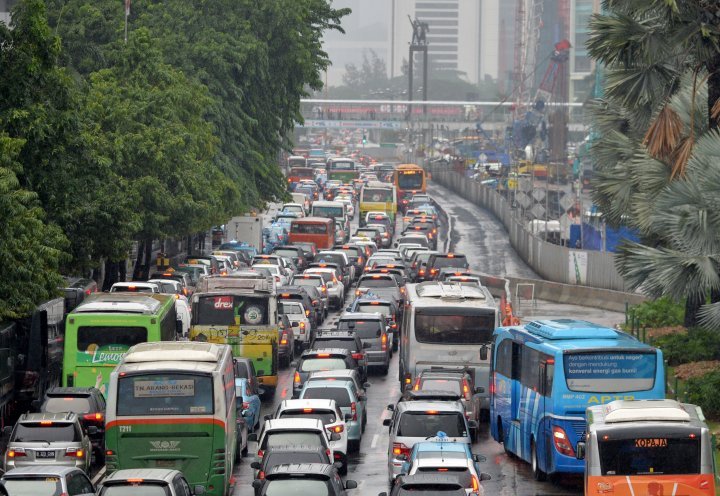
I am no longer surprised when I hear that Jakarta is one of the megacities least safe for women in the world[1]. Specifically, Jakarta ranks ninth out of nineteen cities with populations of more than ten million. This survey, published by the Thomson Reuters Foundation, consists of four assessment categories: first, the level of sexual harassment; second, access to health facilities; third, cultural practices; and fourth, economic opportunities for women.
The perEMPUan community, which focuses on providing information on preventing and handling sexual violence in public places and vehicles, has found several forms of sexual violence that women often experience. At one school they visited for a Safe Transport(a)ction program workshop, a student told of a harassment incident they had witnessed: a male motorcyclist suddenly stopped and exposed himself to people near the school area. Certainly, this is very worrying.
In several of its surveys, perEMPUan also found respondents who had been harassed while using online taxi services. The harassment took the form of being chatted up during the trip and being forced to listen to the driver’s sexual activity. Some respondents also said they felt very uncomfortable when male passengers stared at parts of their bodies for a long time while riding public transport, such as the Commuter Line trains and TransJakarta.
Although the government has taken measures to prevent sexual violence through programs such as women-only carriages, buses, and special sections for women in public transport, Jakarta has not automatically become a more women-friendly city. Since being implemented on the Electric Rail (KRL) in August 2010 and on TransJakarta in 2011, women-only carriages and areas have still sparked debate. The debate ranges from the reasons for their existence being poorly understood by the public, to their effectiveness in protecting women from sexual violence.
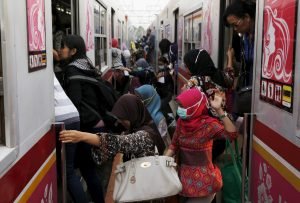
These women-only carriages are often seen as special treatment for women, which actually gives an impression of unfairness. Not only men, but many women themselves feel that women end up looking weaker and more spoiled when they need their own carriages. This policy, often called affirmative action, is indeed discriminatory, but in fact it is positive and is only applied temporarily to certain groups of people who are disadvantaged. In this case, women are disadvantaged by a patriarchal culture and rape culture.
According to data from Komnas Perempuan (the National Commission on Violence Against Women), throughout 2016 there were 3,945 cases of sexual violence[2]. That is only what was recorded and reported; many women are reluctant, too afraid, or simply do not want to report the sexual violence they have experienced. Being a victim of sexual violence is still considered shameful and can damage relationships with the people around them.
On social media, some victims have begun to post about the sexual harassment they have experienced[3]. Generally, they share it as a warning to be careful of sexual violence in public places. However, few still take such incidents to the legal system. Why is that? Often, victims of sexual harassment do not report because access to justice is difficult. Many victims also feel hopeless about how their case will proceed. Not to mention law enforcement that is not gender-sensitive, that belittles victims, and that tends to blame them.
An extreme example happened in 2014, when a woman was raped at the Harmoni TransJakarta shelter by four TransJakarta employees. After struggling hard to bring her case to court, the victim still had to face cornering questions such as what clothes she was wearing, how short her pants were, and why she went out alone while sick[4]. The victim also faced media coverage that was insensitive to her case and that tried to find flaws in her conduct. Besides being irrelevant, this shows that a victim blaming mentality is still very strong, which in fact paves the way for impunity for perpetrators.

That is why the Law on the Elimination of Sexual Violence (UU PKS) is so badly needed in this country. The UU PKS would provide protection and a guarantee that women will have the right to feel safe anywhere. It would also ensure that perpetrators of sexual violence are firmly punished according to their actions. Moreover, with a strong legal foundation, women who are victims would not be afraid to report and fight for themselves. Unfortunately, to this day the RUU PKS (Sexual Violence Elimination Bill) has still not been passed.
It is no surprise that Jakarta has been a city unsafe for women all along. This is not only because its residents have the potential to become perpetrators or to look the other way, but also because the government is still negligent in maximizing protection for women.[]
*To learn more about preventing and handling sexual violence in public places and vehicles, please visit perEMPUan’s Instagram or Twitter at @_perempuan_
Source:
[1] The World’s Most Dangerous Megacities for Women 2017 (http://poll2017.trust.org/)
[2] Sexual Violence Elimination Bill and the Fate of Indonesian Women (https://kumparan.com/utomo-priyambodo/ruu-penghapusan-kekerasan-seksual-dan-nasib-perempuan-indonesia)
[3] Rubbing Genitals and Others: Stories of Sexual Harassment of Women on the KRL (http://www.tribunnews.com/metropolitan/2017/04/18/menggesek-kelamin-dan-lain-lain-cerita-pelecehan-seksual-terhadap-perempuan-di-krl)
[4] Being Right Doesn’t Always Win – The Hard Struggle of a Rape Victim Whose Story Did Not End Happily (http://kartikajahja.tumblr.com/post/91041756653/benar-tak-selalu-menang-kisah-perjuangan-berat)
Photo:
liputan6.com
time.com