Bhinneka Tunggal Ika, or “unity in diversity,” is a motto we always hear in Civics lessons. But do we actually carry that motto into our everyday lives?
Indonesia’s extremely diverse cultural background means that the terms tolerance and discrimination are no longer unfamiliar. The lessons at school when we were in elementary school always made me associate the word tolerance with peace. Imagine a world where everyone is always smiling and speaking kindly to one another, even though their appearances, clothes, and skin colors differ. In my imagination, soft music always plays, truly building a peaceful atmosphere. I always thought that tolerance and discrimination were like oil and water, unable to mix. “How could someone who understands the value of tolerance discriminate against others who are different from them, right? How could such a beautiful, peaceful world have people who discriminate against others? If that did happen, then that world would be intolerant, wouldn’t it?”
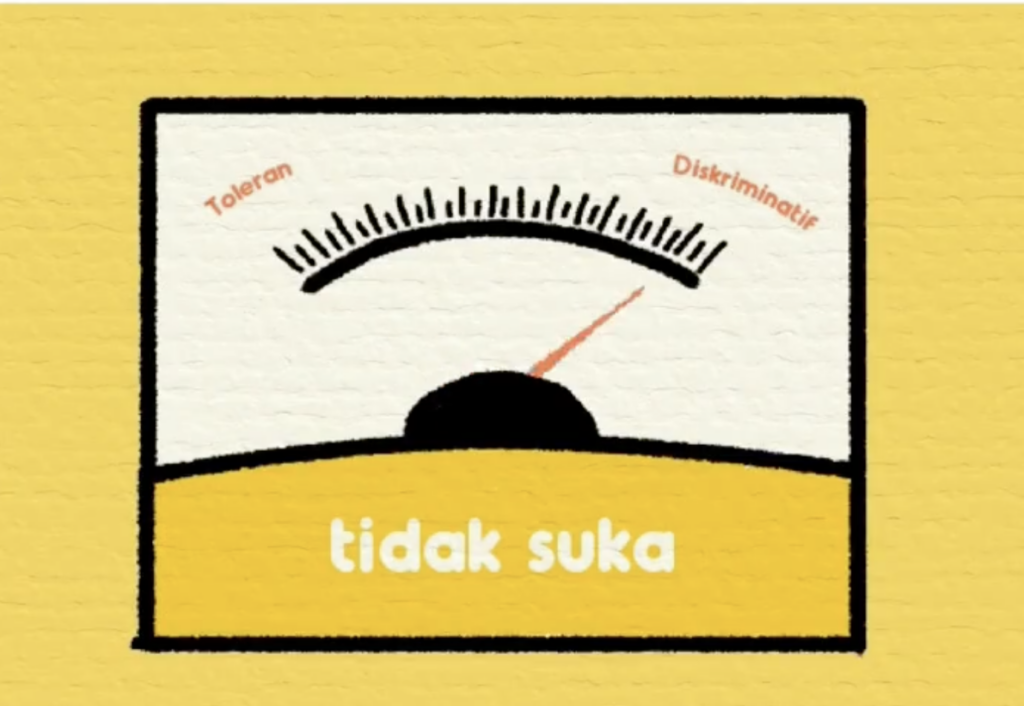
As I grew older, I came to understand tolerance and discrimination as a continuum, where the two sit at opposite extremes. I understood this after seeing how many people consider themselves tolerant, yet only toward certain groups or identities that differ from them. For example, some people are tolerant of others who have a different religion from theirs, but not of people from a different ethnic group. Or there may be people who are tolerant of others from Ethnic Groups A, B, C, and D, but not of Ethnic Groups E, F, and G. Can such a person be considered as not understanding the value of tolerance?
One mind-blowing statement I read recently is the definition of tolerance offered by Walzer (1999). Walzer explains that tolerance is an attitude or behavior of accepting something that one dislikes (resigned acceptance). It turns out that the value of tolerance we have glorified since elementary school can arise and be felt only after being preceded by a feeling of dislike. It may be dislike of a certain behavior, for instance a teacher in class tolerating our being late to class, or dislike of another person’s identity, for instance when I tolerate someone whose level of education is below mine. In essence, the perpetrator of tolerance is someone who actually has the power not to tolerate what they dislike, but chooses to accept it and do nothing about what they dislike (Engelen & Nys, 2008).
This makes my understanding clearer: tolerance and discrimination indeed lie on a long continuum. Both are rooted in the dislike felt by the group that holds power. The difference between the two is as thin as the perpetrator’s decision either to accept what they dislike and do nothing, or to reject what they dislike and do something about it. Realizing this makes me shudder. Imagine how many groups without power hang their lives on the acceptance or rejection of those who hold greater power.
Having dismantled my personal understanding of the word tolerance, which I once believed in wholeheartedly, I now understand what many people have been saying lately: tolerance alone is not enough. If we rely only on tolerance, we will live under the shadow of anxiety about when the group that holds power will decide not to be tolerant anymore, since their dislike will always remain, right?
Many have offered solutions because tolerance alone is indeed not enough. Some push for inclusivity, some offer mutual respect, honor, and love, and others promote mutual acceptance. Walzer (1999) describes various attitudes a person or group may take when facing difference, one of which is pluralism, which sees difference as a social fact or reality that not only colors life but also needs to be preserved and celebrated. People with this pluralist view will encourage difference (enthusiastic endorsement of difference), which ultimately provides a space for everyone to have meaningful personal autonomy. Naturally, under such conditions, every individual, regardless of identity and background, can develop to their full potential.
Moving from tolerance to pluralism is certainly not easy. Embracing pluralism means completely discarding the dislike that is the foundation of tolerance and discrimination, and beginning to give meaning to difference with a positive attitude. Don’t forget, pluralism also shapes us into people who want to encourage difference. It is not merely opening spaces for people who are different (and who may not hold power), but also supporting them so they can fill those spaces.
References:
Engelen, Bart & Nys, Thomas. (2008). Tolerance: A Virtue? Towards a Broad and Descriptive Definition of Tolerance. Philosophy in the Contemporary World. 15. 10.5840/pcw20081515.
Khadafi, M. (December 25, 2015). Accessed September 13, 2020 from https://kabar24.bisnis.com/read/20151225/15/504869/uskup-agung-jakarta-toleransi-saja-tidak-cukup?fb_comment_id=1006191622755494_1006269989414324
Napitupulu, E. L. (December 4, 2011). Accessed September 13, 2020 from https://edukasi.kompas.com/read/2011/12/04/15404549/tidak.cukup.toleransi.saja.tetapi.menerima.keragaman
Satuharapan.com. (May 20, 2016). Accessed September 13, 2020 from http://www.satuharapan.com/read-detail/read/hilmar-farid-toleransi-saja-tidak-cukup
Walzer, M. (1999). On Toleration. London: Yale University Press.